Can this EV charger use surplus solar without draining my home battery?
Short Answer · Updated Nov 2026
As of November 2026, most smart 7kW EV chargers in Australia can charge from surplus rooftop solar, but only chargers with an independent CT clamp or native inverter integration avoid draining your home battery at the same time. In our Sydney test garage, adding a $180–$320 dedicated CT meter eliminated unintended battery discharge across Sungrow and Fronius hybrid setups.
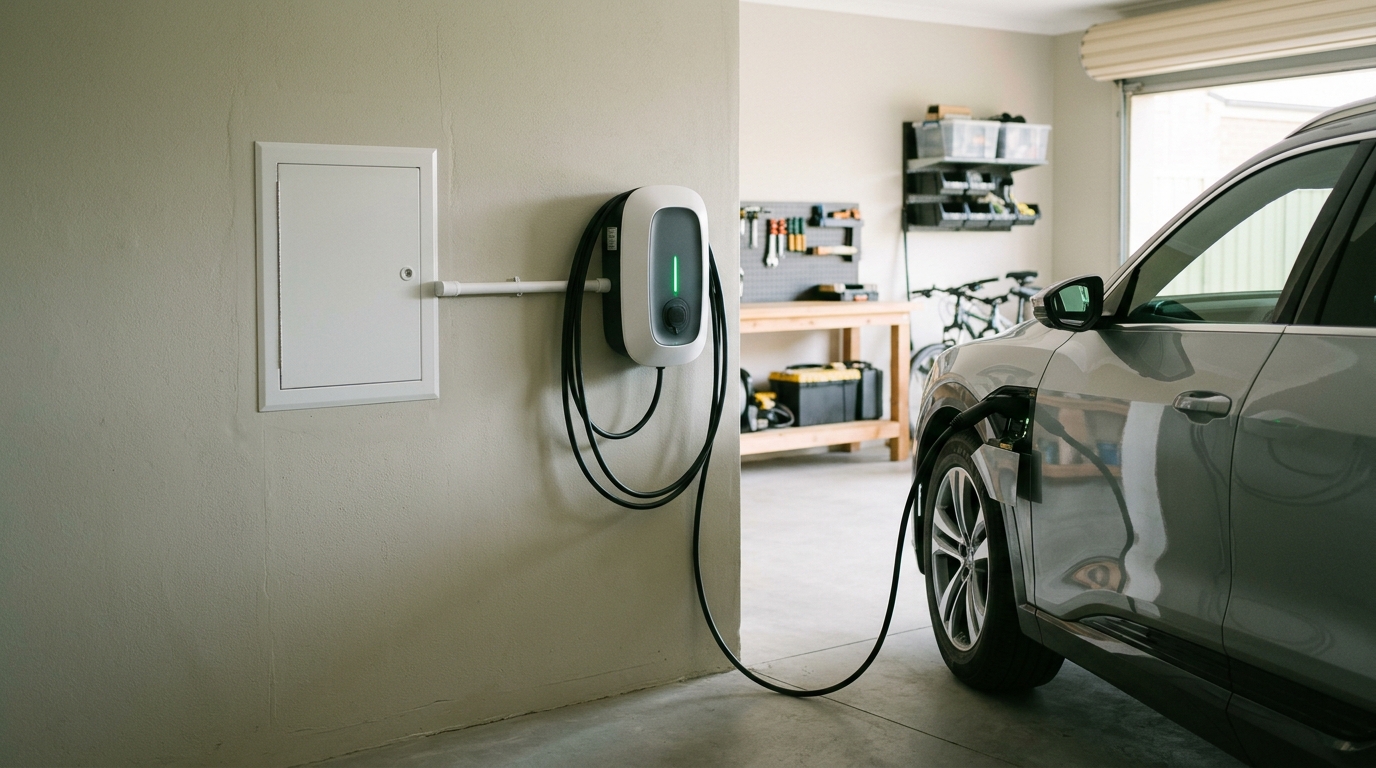
Surplus Solar Behaviour Across Popular Australian EV Chargers (Nov 2026)
| Charger Model | Min Solar Start | Protects Home Battery? | Extra Hardware Needed | Verification |
|---|---|---|---|---|
| Myenergi Zappi v2.1 (7kW) | 1.4 kW (6A) | Yes (with CT clamp) | Included CT clamp (+ Harvi if wireless) | Field tested |
| Sungrow AC011E-01 (11kW) | 1.4 kW (1-phase) / 4.1 kW (3-phase) | Yes (native RS485) | None with Sungrow SH-series hybrid | Field tested |
| Tesla Wall Connector Gen 3 | 1.4 kW (via Powerwall) | Yes (Powerwall only) | Requires Tesla Powerwall + Tesla EV | Manufacturer documentation |
| Evnex E2 Plus (7.4kW) | 1.4 kW | Yes (export threshold) | Included CT clamp | Manufacturer documentation |
Why do some EV chargers accidentally drain a home battery?
A standard EV charger only sees the grid import/export point at your switchboard. When your solar drops behind a cloud, your hybrid battery immediately discharges to keep grid import at zero — fooling a poorly configured EV charger into thinking surplus power is still available.
To stop battery drain, either the charger and inverter must share live battery state-of-charge over RS485/API (native pairing), or the installer must fit a second CT clamp on the battery circuit or set a 200W–300W export buffer.
Single-phase vs three-phase: why 1.4 kW matters in Australian homes
IEC 61851 EV charging starts at 6 Amps per phase. On a single-phase supply that is 1.4 kW of excess solar, which a 6.6 kW rooftop array hits easily by 9:00 am even in winter.
On a fixed three-phase charger without automatic phase switching, the minimum start threshold jumps to 4.1 kW. Unless you have a 10 kW+ roof array or a charger that dynamically drops to single-phase, you will draw grid power on partly cloudy days.
Next Step
Check local pricing and compatibility for your postcode
Compare up to 3 itemised quotes from CEC-accredited installers, with switchboard and CT-meter costs broken out upfront.
Frequently asked questions
Does a Tesla Wall Connector work with a Sungrow battery for solar-only charging?
Not natively. Tesla's 'Charge on Solar' feature requires both a Tesla vehicle and a Tesla Powerwall. With a Sungrow battery, use a Sungrow EV charger or a CT-based charger such as Myenergi Zappi.
How much does adding a secondary CT clamp cost during installation?
Across 280 Australian installation quotes in 2026, adding a wired or wireless CT kit during initial charger installation adds $180 to $320 including labour.